Uploaded by Ian Mauro
Inuit
we've spoken with believe that nanuuit - polar bears - are increasing in
abundance. The
stories of elders clearly indicate that in the past this great animal was not
seen often, but when it was, it was a very special event. In Inuit society, the
bear is revered for its intelligence, strength and importance within the
foodchain. Like all animals, Inuit believe the bear should never be tampered
with unless it is being hunted as a source of food.
Now,
local observations indicate that polar bears are increasing in numbers, in
large part due to the community-based conservation efforts of Inuit. These
animals are now spotted more regularly in both camps and communities. Nunavut
is home to most of Canada's estimated 16,000 polar bears, which is 2/3rds of
the world's population, and annually, Inuit hunt about 325 of them for food,
clothing and other culturally appropriate reasons (Foote and Wenzel, 2009).
Additionally, Inuit communities will open their quota to "conservation hunting",
and approximately 75-175 bears are caught annually by non-locals, which helps
with economic development in these often cash-strapped communities (Foote and
Wenzel, 2009). These conservation hunts are rigorously regulated and must
be conducted in the traditional-style, using dogteams or by foot, and can last
two-weeks and require up to 500 km of travel (Foote and Wenzel, 2009).
Unfortunately,
in the south, Inuit use of animals such as the polar bear is poorly understood.
Arguably, Inuit hunting of seals and polar bear are amongst the most contested
environmental issues of our time. This conflict is largely a result of the
different world views between southern environmentalists and scientists, and
Arctic indigenous peoples.
Most
wildlife biologists believe that bears are at risk due to climate change. A
major concern is that the loss of sea ice, due to warming, will significantly
disrupt polar bear habitat and their ability to successfully hunt and procure
calories. These arguments have been quite persuasive in policy circles and, in
2008, the US listed the polar bear as "threatened" under their
Endangered Species Act. This was the first time in the world that an animal had
been listed as threatened due to climate change. Now, the US is advocating
internationally that the polar bear be listed as threatened on the Convention
on International Trade of Endangered Species (CITES), which would make the
Canadian export of any polar bear materials illegal. Inuit, particularly in
Nunavut, are dismayed by and largely disagree with this turn of events, and
believe that their rights and knowledge regarding this species are not being
respected. See ITK's press release for more details:
Inuit Disappointed at US Activism on CITES Polar Bear Up-Listing Proposal
Scientists
often study the bear by tranquilizing, tagging and tracking it. While this
technique has certainy provided important scientific information about the
species, many Inuit believe that these practices are also harmful and
disrespectful. Inuit have told us that "tampering" with bears in this
way can stress them further and make them irritable. Indeed, Pangnirtung's
Jamesie Mike told us that problem bears - such as the ones that destroy
property or act aggressively towards humans - are always the ones that have
been previously captured by scientists. Everywhere locals have told us that when bears are
harvested, they often are already tranquilized, and this meat is not
eatten because it is viewed as being unsafe. Inuit expect and prefer that their
countryfood is natural and without chemicals. Ironically, Arctic communities
often assist biologists in gathering data about wildlife, and in the case of the bear, this may have backfired.
When
it comes down to it, it's about whether you believe in the ability of
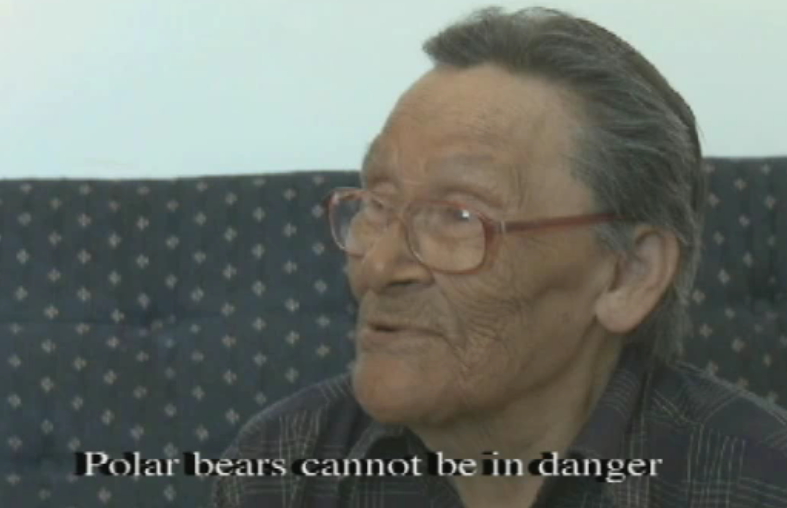
the world to adapt. Elders, like Jamesie Mike, disagree
with scientists that polar bears will be in danger if we lose ice. As
Jamesie
says in the video upload, the bear is a sea animal first and foremost,
and he is confident that it, like Inuit, will survive and adapt in a
warming world. Interestingly, Jamesie's description of a polar bear
matches its scientific name "Ursus maritimus" that
means "sea bear".
Indeed,
there's a lot of common ground between elders and scientists, as they are both
experts in their own systems of knowledge. As our project unfolds, you'll be
able to see how Inuit knowledge and science often support one another, which is
a promising sign for the future. However, in areas where they disagree, it's
important that both sides of the story are heard, and that is our job, to bring
you that Inuit point of view.
Stay
tuned and we'll continue to bring you the most up-to-date and interesting Inuit
climate change perspectives the internet has to offer.
Source:
Foote,
L. and G.W. Wenzel. 2009. Polar Bear Conservation Hunting in Canada: Economics,
Culture and Unintended Consequences. In. Freemon and Foote (Eds.). Inuit Polar
Bears and Sustainable Use: Local, National and International Perspectives. CCI
Press.