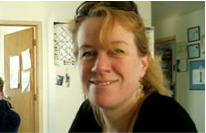
Uploaded by Nathalie Kalina
How did you get started in this industry?
I studied film in university in Copenhagen. Besides that, everything
I do today as a producer and a filmmaker is self-taught. It's a
combination between an academic degree and everything I've done since,
so it's learning by doing. I was very preoccupied with video and the
video scene in the late '80s and early '90s. I was running a place
called the Video Gallery in Copenhagen and then took off to be in more concrete productions. I have a very personal way of learning what I know today.
What do you think of Igloolik so far?
I think Igloolik is something I've never experienced before. I'm
very overwhelmed by being here, it's a special thing to know that we're
a little bunch of people surrounded by this whole enormous land; like a
huge desert. It's a very physical experience. I think it's fantastic to
be here, and it's so unique to see what Igloolik Isuma Productions are
doing here. I think that the places I've been in Greenland and other
remote communitites are different just because here I've experienced
Igloolik through you guys, but that's also a very precise way of being
here. I'm very impressed and happy to be here.
What are the biggest differences between Denmark and Igloolik?
Everything! Denmark is a small country, about five million people,
there's not much space and no danger whatsoever. There's no blizzards,
no extreme cold, no high mountains, no dangerous animals. It's probably
one of the most peaceful little countries in the world. And people are
very very social, they love to talk and exchange and I think that goes
with the fact that there's not that much space. It's a very cultured,
small country with a lot of social exchange. All Danes have at least
one other language that they speak other than Danish, so in that way
it's a bit similar to here because if your mothertongue is Inuktitut,
you'd have to also know other languages. That means that you are used
to other cultures and other ways of doing things , from the very
beginning. In that way we're alike, and in America, it's very
different. They assume that English is all over, and it changes the
minds of the people. Besides that everything is different.
What drew you to work at Isuma?
I have known Norman Cohn for many years. We've know each other since
we were both preoccupied with video and new technologies and media and
all that. I think that the work here is really important. I think that
the style is very authentic, a big preoccupation with authenticity. In
fiction, it's something that I work a lot with at Barok, it's a style
that we're also happy working in. At Barok, the company that I work at,
we don't really distinguish that much between fiction and documentary.
We like to have a very precise blend of the two genres. The only way I
can elaborate on that is to be concrete and tell you about what we have
been doing; that goes for Isuma as well. It's to be precise and to say
'ok, here's this film and here's how we do it here'. But I think
filmmaking has those two sides, it has something completely imaginary
and something completely real about it. That is what I think Isuma uses
in a very interesting, new way. I think that's what we at Barok is all
about. It's fantastic to be making a film that combines the cultures of
Canada, Greenland, and Denmark. And it's fantastic to be a part of a
film that the language will be Inuktitut, Danish, and Greenlandic. I
think there's a hunger in the audience for exactly that authenticity;
the fact that it is being made here, the fact that this is where it
happened 80 years ago, and that's always a quality to achieve in the
way people work and think about the film.
What are your role and responsibilities here?
I'm the Danish producer so I'm here to see to that the Danish and
Greenlandic elements in the film are being integrated in the best way I
can. Isuma has sort of 80% of the film and Barok has 20% you could say.
By that I mean both in terms of the financing, but also in terms of the
artistic contribution. From Denmark and Greenland we have seven actors
all together and we have a lot of props and costumes that need a lot of
attention and effort to make. The big jump now, everyday, is to make it
a film, film crew, and cast. No longer some people who work in
Igloolik, some people who work in Greenland, and some people who work
in Denmark, because that's the proper way to ensure that everyone has
the same vision and everyone knows where they're going. I know that's a
very abstract answer, but there are some very concrete things that I do
everyday. We just received the four Greenlandic actors and they're
being introduced to everything, and start to get into the whole system
here. It's a whole little universe you have created here, so we have to
get into that, otherwise it won't work.
Besides that I'm trying to branch out as much as I can. For
instance, we now have in a Danish newspaper and a Greenlandic
newspaper, diaries that the actors are making. I'd love to be able to
give you guys input for the SILA website so that your project mirrors
the fact that there are these three cultures, or maybe even more than
that. I think that Canadians feel that Greenland is further ahead
culturally in some aspects, but on the other hand, there's no such
thing as Isuma Productions, there's no energetic centre for people to
go take part of the action, to find out what you want to be, there's no
such thing. So we're trying to involve people in Greenland, and we're
trying to see if we can inspire them to go out there for themselves;
this is probably the better way of doing it, rather than them having to
go to Copenhagen, because it's not the same thing. This is closer to
what they want and what they know. The Greenlanders here are really
full of joy and admiration for the work that's being done here, and
Atanarjuat means a tremendous amount to them. It's a big thing, not a
small thing at all. So this is about what I can do for them, maybe I
can't do anything at all, maybe I can only do a little bit, but I don't
know exactly what and how, but we're trying.
What's the biggest problem you've faced so far?
I don't have any problems, I have some challenges, I don't have any
problems. It was a challenge to finance the film in Denmark because
it's hard to explain how...it's so specific how Zacharias, Norman and
Isuma work together, and their style. That's been a challenge to fund
the Danish and Greenlandic part. It was a challenge to find the right
people to work with in Greenland, just because I'm not from there, it's
a big country and another culture from mine and isn't always easy to
access. So I don't have any problems or crisis - so far (laugh) it'll
come.
Can you tell me about the Danish view of the Knud Rasmussen story?
Knud was a hero of the people. He was a very mythical figure and he
was the one who connected in his person, in a very kind and visionary
way, the aristocracy of the Danes and the way of life of the Inuit. I
told you about Denmark being a small but social country and Greenland
is a very vast and remote country, so he was able to live well in both.
He had a foot in each camp. Knud, with his charm and with him being a
quarter inuit and Danish, he loved being on the road but also living
the social scene in downtown Copenhagen - going to celebrity parties.
He personalized, in a way, the best of the relationship between Denmark
and Greenland. It's really important.
Can you walk me through your typical day?
My typical day starts very early, I get up and I write for a little
bit, and I usually have a meeting with my co-producers; with Norman. We
go through the day. I always wake up a bit early because I have
practical things to do. We're six hours behind Denmark, so where are
the props now, who's on the plane, when's it coming in, they have
already sent me that information and are about to leave the office when
I'm ready to do my business. So I try to be on the computer as soon as
possible so I can get back to those people and see if there's anything
that needs to be solved. So far it's been about housing; who lives
where? Do they have a phone and a bed? Do they have warm enough
clothes? Why are the props stuck in Montreal? Who forgot what? It's all
just practicalities really. But people are working very well, it not
like it's something I'm stressful about right now.
Any plans for after this project?
Right now, I think I'm working on 15 projects, this one's the
biggest. I think that, generally, Barok is heading more towards bigger
projects, and that after five years in business, we're getting more
precise about what we want to do. We're at a point where we can still
sit and talk about our visions, etc. about what we want our fim
business to be and what kind of films we want to make, and it's
important. But I think the actual knowledge, the real, solid knowledge
about what it means comes through somehow. So I feel now, after five
years with Baroque, that we're getting ready to have that really
precise sense of what we want to do. It's very personal, high quality
visionary films.